Costs & Process
A flue liner is a continuous stainless steel tube running from the appliance to the chimney terminal, sized for the appliance rather than for the masonry it sits inside. Fitting one turns an old, oversized, porous flue into a smooth, correctly proportioned one.
It is also the single biggest variable in most stove quotes, so it is worth knowing what the work involves and where the cost sits.
Sizing: the number that matters most
Liner diameter is dictated by the appliance outlet and by the manufacturer's requirement, not by what will physically fit down the stack. Common domestic sizes are 125mm and 150mm, with 125mm typical for many modern room stoves and 150mm where the appliance or the installation calls for it.
Going larger is not a safety margin. An oversized flue cools the gas, slows the draught and encourages condensation, which is exactly the problem lining is meant to solve.
Grades: 316 and 904
Flexible liners come in different stainless grades, most commonly 316 and 904. The higher grade offers greater resistance to the acidic condensates produced by some fuels and is the usual choice where mineral fuels are burned regularly or where the installation is hard to access for future replacement.
Manufacturer warranties differ by grade and by how the liner is used, and burning wet wood will shorten the life of any liner regardless of what it cost. Fuel discipline protects the investment more than grade selection does.
- 316 grade: widely used for wood burning appliances
- 904 grade: heavier duty, favoured for regular mineral fuel use
- Liner is fitted the correct way up, which is marked and matters
- Joins are avoided in a domestic drop wherever the length allows
The day itself
Work starts at the top. The pot or existing terminal is removed, the flue is swept and checked, and the liner is drawn down the stack, usually with a nose cone and rope from above and a second person guiding it at the fireplace. Old flues are rarely straight, and this is the part that takes the skill.
At the bottom the liner is connected to the appliance with an adaptor. At the top it is supported by a clamp plate and finished with a cowl or terminal. The void between liner and masonry is commonly backfilled with insulation, which keeps flue gas temperature up and improves the draught.
Access decides the shape of the day. A single storey rear extension is straightforward. A tall gable on a slope may need scaffolding, and that changes both the cost and the lead time.
What we check before quoting a liner
A camera survey removes the guesswork. It shows whether the flue is clear enough to take a liner, whether there are offsets or breaches, and whether the stack itself needs attention first. Occasionally it shows that the flue does not need lining at all, and that is a perfectly good outcome.
- Internal condition and any obstructions, offsets or breaches
- Whether the stack and pot are sound enough to work on
- Realistic access route and whether scaffold is needed
- Existing appliance outlet size and orientation
Working around the building
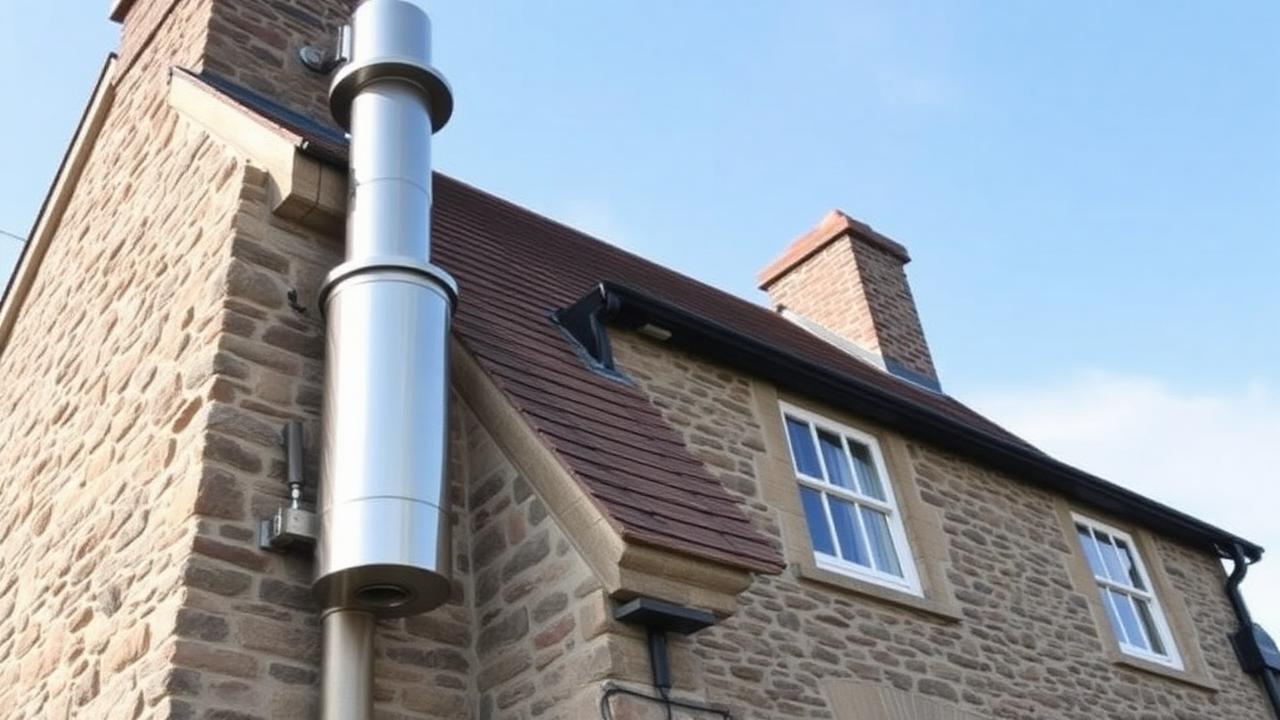
Lining is one of the few stove jobs that involves the outside of the house as much as the inside, and that changes what a good day looks like. Roof tiles or slates have to be worked around rather than through. Neighbours in a terrace deserve warning if a shared stack or a shared close is involved. Parking has to be sorted so that a full length of liner can be handled safely.
In tenement and terraced settings the stack is often shared between properties, with several flues rising inside one structure. That is entirely normal, but it means a camera survey earns its keep by confirming which flue serves which room before anything is drawn down.
Conservation areas and listed buildings add one further step, because what appears above the roofline is visible and sometimes controlled. Terminals can usually be chosen to be discreet, and it is far easier to plan that at survey than to argue about it afterwards.
Common findings from the camera survey
The camera earns its place because most of what matters is invisible from either end. Parging that has crumbled away from the brickwork is extremely common in older Scottish stacks and is exactly the sort of thing that makes lining sensible rather than optional.
Offsets, where the flue steps sideways to clear a floor or another flue, are normal and usually workable. What stops a job is a sharp change of direction, a partial collapse or a breach into an adjoining flue, and knowing about any of them beforehand is the difference between a planned repair and an abandoned day.
- Failed parging and loose mortar inside the flue
- Old nesting material and debris resting on a ledge
- Tar glazing from years of burning wet fuel
- Offsets and, occasionally, breaches into a neighbouring flue
- Deteriorated flaunching and a pot that needs bedding before any cowl goes on
Signs an existing flue needs lining
Not every chimney needs a liner, and we will say so when one does not. The cases where lining is the right call tend to announce themselves during the survey rather than being a matter of opinion.
Smoke or smell appearing in a room other than the one with the fire is the clearest signal of all, because it means flue gases are finding a route through the masonry. Persistent damp staining on a chimney breast points the same way. A camera showing crumbling parging, an old flue serving a much larger opening than the new appliance needs, or evidence of a previous fire in the stack all lead to the same recommendation.
Where none of those apply and the flue tests sound, connecting into it directly is a perfectly legitimate outcome and saves a great deal of money.
- Smoke or smell in adjoining rooms
- Damp or tar staining on the chimney breast
- Failed parging or loose material seen on camera
- A flue far larger than the new appliance requires
Sizing the liner to the appliance
Diameter is decided by the appliance, not by the size of the opening or by what happens to be on the van. A liner that is too small chokes the fire and can push flue gases where they should not go. A liner that is too large runs cooler, which sounds harmless and is not, because a cool flue condenses and a condensing flue builds tar.
The appliance data plate and manufacturer instructions state the flue size the stove was tested with, and that is where the number comes from. Where an old opening is far larger than the liner, the void around it is filled or insulated rather than simply left, both to keep the liner central and to keep flue temperatures where they should be.
This is also where the fuel conversation returns. A flue serving an appliance burning mineral fuel regularly leads us towards a heavier grade of stainless, because the combustion products are harsher on the steel over a lifetime of use.
- Diameter taken from the appliance instructions, not the opening
- Grade chosen with the intended fuel in mind
- Void around the liner insulated or backfilled rather than left open
- Adaptor, clamp plate and terminal matched to the same system
Rigid liner, flexible liner and relining an old system
Flexible stainless liner is the standard answer for a domestic stove in an existing masonry chimney, because it copes with the offsets real chimneys contain and can be installed in one continuous length from top to bottom. Rigid systems have their place, generally where a flue is straight, accessible and being built rather than retrofitted.
Relining an already lined chimney is a job we see more often than you might expect, usually where an older liner has been damaged by years of wet fuel or was never the right diameter to begin with. Removal comes first, and it tells you a great deal about how the previous installation was treated: a liner that comes out clean has been looked after, and one that comes out glazed with tar has not.
Whichever route applies, the appliance sets the diameter, the fuel and use pattern inform the grade, and the building decides the access. Those three inputs produce the specification, and none of them can be skipped.
Aftercare
A lined flue still needs sweeping. Liners are swept with appropriate equipment rather than heavy traditional rods, and an annual sweep is the normal cycle for regular wood burning. It is also the moment somebody looks at the terminal, the clamp plate and the general state of the stack.
Frequently asked questions
How long does lining a chimney take?
A straightforward liner drop is generally part of a single day's work alongside the appliance. Difficult access, offsets in the flue or scaffolding will extend it.
What size liner will my stove need?
It follows the appliance outlet and the manufacturer's requirement. 125mm and 150mm are the common domestic sizes. It is never chosen simply because a bigger one fits.
Is 904 grade worth the extra over 316?
It is the usual choice where mineral fuels are burned regularly or where future replacement would be difficult. For a wood only appliance in an accessible stack, 316 is very commonly specified.
Does a liner need insulating around it?
Backfilling the void is standard practice on most domestic installations because it keeps flue temperature up and the draught steady. It is included in the quote rather than treated as an optional extra.
Can a liner be fitted to a chimney with bends?
Often, yes. Flexible liner copes with gentle offsets. Sharp changes of direction or a partially collapsed flue are what stop the job, which is why the camera survey comes first.
How often does a lined flue need sweeping?
At least annually for regular wood burning, and more often for heavy use. Sweeping a liner uses appropriate equipment so the liner itself is not damaged.
Get the flue looked at before the quote
A camera survey tells us whether your chimney needs lining, and if it does, what size and grade suit it. Get in touch and we will book a look.