Comparisons & Choices
A cowl is a small piece of metal that fixes one specific problem. That is the whole trick to choosing one: identify the problem first, then pick the cowl designed for it. Fitting a general purpose cap because the chimney is misbehaving is how people end up with a worse draught than they started with.
Coastal towns in Angus and North Fife, exposed sites in East Perthshire, and terraces where one stack stands lower than its neighbour all throw up different symptoms. Below is the honest matching exercise.
Bird guards
A mesh guard over the pot stops jackdaws building in the flue. This is the most straightforward cowl decision there is: if you have had a nest, or you have an unused flue in a town with a healthy jackdaw population, you want one.
Mesh size matters. Too fine and it blinds with soot; too coarse and a determined bird gets through. It also needs to be a design that can be removed for sweeping rather than one that has to be cut off.
Rain caps
A simple cap keeps water out of the flue while leaving it open for gas to escape. Water in a flue is a slow problem rather than a dramatic one: damp staining on chimney breasts, salts drawn through plaster, and mortar degrading inside the stack.
Most modern cowls combine a cap with a bird guard, which covers the two commonest issues at once.
Anti downdraught cowls
Downdraught is wind driving air back down the flue, and it produces the symptom people describe as the fire breathing backwards. It is common where a stack sits low relative to a roof, a hill, a taller neighbouring building or a stand of trees.
Anti downdraught designs work by using the wind itself to induce a draw across the flue outlet. Rotating cowls that turn with the wind, and static aerofoil designs with no moving parts, both address this. Rotating types are effective but have a bearing that will eventually need attention. Static types are fit and forget but bulkier to look at.
- Symptom: smoke puffing into the room in gusty weather, not constantly
- Check first that the flue is swept and the room has adequate air
- Confirm the terminal height relative to the ridge and to obstructions
- Then, and only then, choose an anti downdraught design
Capping cowls for disused flues
A flue that is no longer used should not simply be sealed at both ends. It needs to breathe or it will hold moisture. A capping cowl closes the top to rain and birds while allowing ventilation, and it is paired with a vent at the fireplace.
This is the standard treatment for a chimney kept for future use, and it protects the stack in the meantime.
Cowls for gas and oil appliances
Cowls are appliance specific. A terminal suitable for a solid fuel stove is not automatically suitable for other fuels, and the wrong type can obstruct the products of combustion. Where a flue serves anything other than solid fuel, the terminal is chosen to match that appliance.
Diagnosing the symptom before buying anything
The most useful thing you can do before spending money on a cowl is pay attention to when the problem happens. A fire that smokes only in gusty weather, or only when the wind comes from one direction, is telling you about wind. A fire that smokes consistently, in every condition, is telling you about the flue, the fuel or the air supply, and no terminal will help it.
A fire that has slowly got worse over two or three seasons is usually a sweeping question. A fire that changed suddenly is usually a blockage, and in spring that very often means a nest. A fire that has never worked properly since the day it was fitted is usually a design question about flue size or terminal height.
Those four patterns cover most of what we are called to look at, and separating them takes a conversation rather than a callout.
- Only in wind: look at downdraught and terminal height
- All the time: look at the flue, the fuel and the ventilation
- Gradually worse: sweeping, tar or a partial blockage
- Sudden, especially in spring: suspect a nest
Coastal and exposed sites
Along the Angus and North Fife coast, salt laden air is unkind to anything on a roof, and a cheap terminal will look tired within a few winters. Stainless is the sensible default in those settings, and it is worth checking the fixings as well as the cowl itself, since a good cowl on a corroded strap is still a cowl on the lawn eventually.
Exposed rural sites in East Perthshire bring a different problem: not corrosion but turbulence. A stack sitting below a hillside or downwind of mature trees can be in disturbed air whatever the weather does, and the fix there is usually about terminal height and an anti downdraught design rather than about materials.
What a cowl can and cannot do
A cowl is a terminal fitting, and its honest job description is short. It can keep rain out of the flue, keep birds and squirrels from getting in, and in the right design it can reduce the effect of wind pushing back down the stack. That is a genuinely useful list and it is also the whole list.
What a cowl cannot do is make a blocked flue draw, compensate for wet fuel, cure a room with no air supply, or fix a flue that is the wrong size for the appliance. Cowls get blamed for all four of those regularly, usually after being bought online as the cheapest possible answer to a smoking fire.
So the order of operations matters. Sweep the flue, check the fuel, check the ventilation, confirm the flue suits the appliance. If the fire still misbehaves in specific wind conditions, then a terminal is genuinely the right conversation to be having.
How terminal height affects everything
Before any cowl is chosen, it is worth understanding that terminal height does much of the work a cowl is often asked to do. A flue that terminates too low relative to the ridge, or too close to a taller neighbouring structure, sits in the zone of disturbed air where the wind can push down as readily as it pulls across.
Sometimes the correct fix is not a cowl at all but extending the flue, either with a taller pot or by raising the terminal. That is a more involved job than clipping on a cap, but it addresses the cause instead of managing the symptom, and where it is the right answer we will say so even though it is the harder sell.
Where raising the terminal is impractical, which is common in conservation settings and on shared stacks, an anti downdraught cowl becomes the sensible compromise rather than the first resort.
Cowls, sweeping and the annual visit
Every cowl we fit has to come off, or open up, for sweeping. It sounds obvious and it is routinely ignored, with the result that a chimney gets a nice new cap and then is never swept properly again because nobody wants to disturb it.
The annual sweep is also the natural moment to inspect the terminal, since somebody is already there with access. Fixings loosen, mesh blinds with soot, and bearings on rotating cowls eventually seize. Catching any of those during a routine visit is far cheaper than discovering them when the fire starts misbehaving in December.
- Choose a design that can be removed or opened for sweeping
- Have the fixings checked at each annual visit
- Clear blinded mesh rather than cutting the guard away
- Replace corroded terminals before they detach, particularly near the coast
Fitting and sweeping access
Whatever type is chosen, it has to be securely fixed to a sound pot or clamp plate, and it has to allow the flue to be swept. A cowl that has to be destroyed to clean the chimney is a cowl that will not be replaced afterwards.
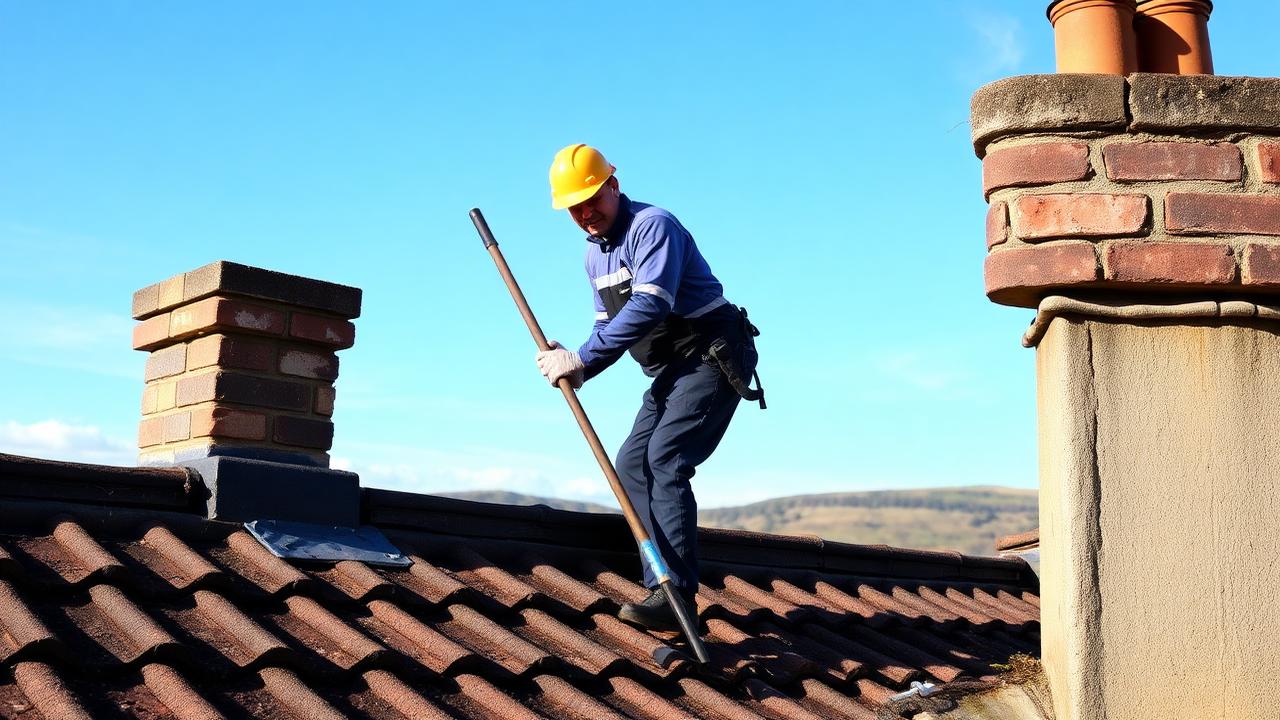
Fitting is roof work, and how it is accessed depends on the height, the pitch and the condition of the stack. We look at all three before agreeing the job.
Frequently asked questions
Will a cowl stop my stove smoking into the room?
Only if wind driven downdraught is the actual cause. A blocked flue or a room short of air produces similar symptoms and no cowl will fix either, so the diagnosis comes first.
Do I need a bird guard if I use the fire every day?
Daily winter use discourages nesting, but the flue sits idle all spring, which is exactly when jackdaws are looking. A guard is cheap insurance either way.
Are spinning cowls better than static ones?
Neither is universally better. Rotating designs are effective against downdraught but have a moving part; static aerofoil designs need no maintenance but are more visible. Site and stack decide it.
Can a cowl be fitted to any chimney pot?
It needs a sound pot or a clamp plate to fix to. Where the flaunching or pot has deteriorated, that gets sorted first or the cowl has nothing reliable to hold on to.
Should an unused chimney be capped completely?
No. Seal it entirely and it traps moisture. A capping cowl keeps rain and birds out while letting the flue ventilate, paired with a vent at the bottom.
Tell us the symptom, not the cowl
Describe what the fire is doing and in what weather, and we will work out whether a cowl is the answer. Cowl fitting is a service we carry out across Dundee, Angus, North Fife and East Perthshire.