Comparisons & Choices
A chimney sweep removes soot, tar and debris from the flue so smoke can leave the house freely. A stove service checks the appliance: door and glass seals, the baffle, fire bricks, grate, air controls and the connection to the flue. They answer different questions, so most people with a wood burner or multifuel stove book both, ideally on the same visit before the heating season.
The confusion is understandable because both involve someone kneeling at your hearth with a vacuum. The easiest way to separate them is to ask what could go wrong. A dirty flue can block, catch fire or push fumes back into the room. A worn stove can leak air, burn too fast or too slow, crack its bricks or let smoke escape round a tired door rope.
What a sweep covers
The sweep clears the whole flue from the appliance to the terminal and checks that it draws. On a stove that means working through the flue collar with the baffle removed. Anything unusual, such as a lot of tar, nesting material or loose masonry coming down, is noted, and you are given a certificate for insurance or letting records.
What a service covers
A service is about the appliance and how it burns. Worn parts are the usual finding: flattened door rope that no longer seals, a warped baffle, cracked fire bricks or a grate that has burned through. Air controls that have seized open make a stove hard to turn down; seized shut, they make it smoke and blacken the glass.
- Door and glass rope seals tested and replaced if worn
- Baffle plate and fire bricks checked for warping and cracks
- Grate, riddling and ash pan checked on multifuel models
- Primary, secondary and airwash controls freed and tested
- Flue connection and register plate checked for leaks
- Carbon monoxide alarm location and function checked
Why booking them together makes sense
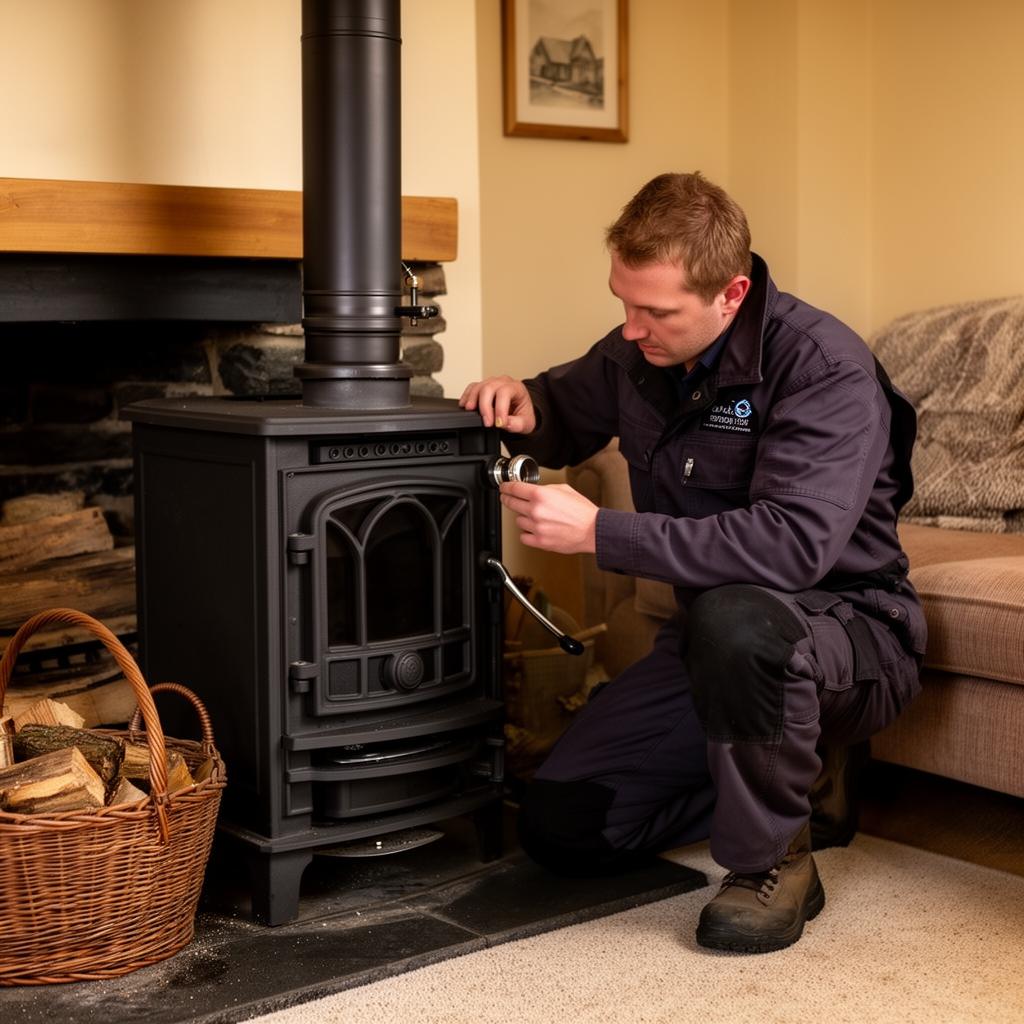
A proper stove sweep already means opening the stove and taking the baffle out. Doing the service at that point avoids stripping the stove twice and lets one person see the whole picture, for example a tar problem in the flue that is really caused by a leaking air control. It also puts both records on the same date, which is tidy for landlords and holiday let owners.
If you only book one
If money or time is tight, the sweep is the safety essential because a blocked flue is the more immediate hazard. But a stove that has never been serviced tends to wear quietly until something fails, often mid-winter when parts take longest to source. Treat the service as the thing that keeps the sweep routine rather than a rescue job.
Common findings that link the two
Some of the most useful discoveries come from seeing the flue and the stove together. Heavy tar in the liner often traces back to an air control that has stuck partly closed, so the fire has been smouldering for months. A flue that seems to draw poorly can turn out to be fine, with the real issue a door rope letting cold air in above the fire and cooling the gases. Blackened glass may be a fuel problem, an airwash problem or a flue problem, and only looking at all three settles it.
Equally, a stove that has been serviced but whose flue has not been swept can look perfect inside while debris gathers higher up. Birds, fallen mortar and loose tar flakes do not show from the firebox. Booking the two together means nothing is assumed and every finding is explained in the context of the whole system, which makes it easier to decide what genuinely needs fixing now and what can wait until the next visit.
Frequently asked questions
Is a chimney sweep the same as a stove service?
No. The sweep cleans the flue; the service checks the stove itself, including seals, baffle, bricks, grate and air controls.
Can both be done on the same visit?
Yes, and it is usually the sensible choice. The stove is opened up for the sweep anyway, so the service follows on without stripping it twice.
Which matters more if I can only do one?
The sweep, because a blocked or tarred flue is the more direct safety risk. Book the service as soon as you can after that.
Do I get paperwork for both?
A sweeping certificate is issued after every sweep. Service findings and any parts replaced are explained to you at the visit.
Book your sweep and service together
One visit for the flue and the stove. Call 07826 049704 or send an enquiry.