Costs & Process
Twin wall flue quotes surprise people, because a house with no chimney needs an entire chimney building — insulated, sealed, structurally supported and weathertight — and that is a bigger piece of work than dropping a liner down an existing stack.
We do not publish prices for this, and any figure you see quoted online without a survey is a guess. What we can do, usefully, is explain exactly which variables move the number, so you can read a quote properly and understand why two houses on the same street came out differently.
Route: internal or external
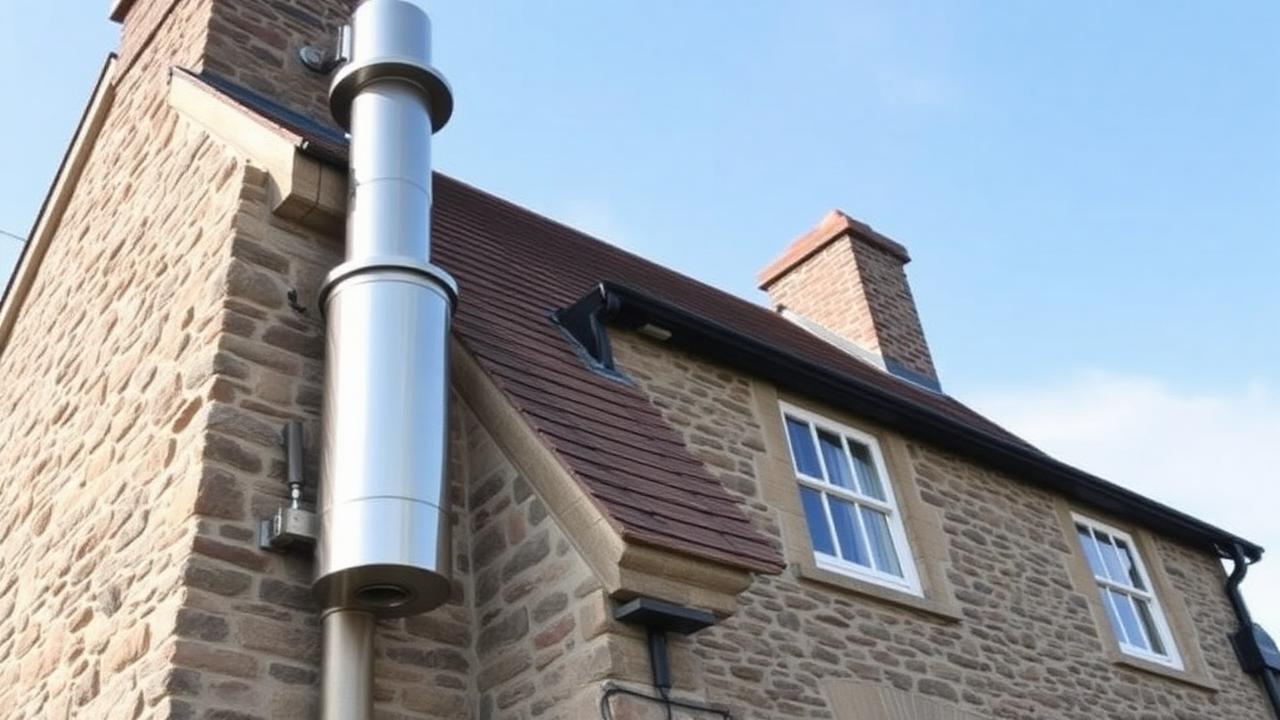
This is the biggest single decision and it drives both cost and performance. An internal route goes up through the ceilings and out through the roof. An external route exits through the wall behind the stove and climbs the outside of the building.
External is often simpler to install and less disruptive inside — no boxing in, no ceiling penetrations, no bedroom above being interfered with. It needs wall support brackets, weathering at the wall penetration and, usually, more flue length overall because it has to reach above the ridge.
Internal keeps the flue warm inside the heated envelope, which produces a noticeably better draw, less condensation and less tar. It costs more in making good — ceilings, floors, boxing, decoration — but it is the better performing installation, and on an exposed site it is often the one worth paying for.
Height, and why the roof matters more than you would think
Twin wall is sold by the component. Every extra metre of vertical run is more material, and the flue has to terminate high enough relative to the ridge to draw reliably rather than merely to reach daylight. A steeply pitched roof, or a stove positioned low on the plan, pushes the required height up quickly.
Roof construction then decides the complexity of the penetration itself. Slate, tile, flat roof and a low-pitch roof all need different flashing and support approaches. Trusses may need supporting or trimming, which is a structural consideration rather than a flue one.
- Total vertical metres of flue, not just floor-to-ceiling height
- Termination height relative to the ridge and roof pitch
- Roof covering and the flashing required for it
- Truss or joist work where the flue passes through
- Wall thickness and construction at an external penetration
Access and scaffolding
Working at height safely has a cost, and it is one of the more common differences between quotes. A single-storey rear extension is a different proposition to a two-storey gable on a sloping site, or a terrace with no rear access.
If a quote is markedly cheaper than others, this is one of the first places to look. Access arrangements should be stated, not implied — the cost does not disappear because the quote is silent about it.
Components people forget to compare
Twin wall is a system of parts, and quotes vary depending on how completely they are specified. Bends, tees, support brackets, wall bands, firestops at each floor level, the register plate arrangement, the terminal and the hearth all appear on a complete quote.
Quality varies too. Twin wall systems differ in insulation thickness, liner grade and guarantee, and the cheaper systems are cheaper for reasons that show up in a decade. Ask which system is being quoted and what its guarantee is, then compare like with like.
- Bends and tees — a straight run is cheaper than a dog-leg around an obstruction
- Firestop plates at every floor or ceiling penetration
- Support brackets and wall bands sized to the run
- Terminal type, including anti-downdraught where the site is exposed
- Hearth construction and any making good to floors and ceilings
- The flue system's grade, insulation and guarantee
How to compare quotes fairly
Get quotes on the same specification. If one installer proposes internal routing and another external, you are comparing two different installations, not two prices for the same one — decide the route first, then price it.
Check what is included beyond the flue: making good, decoration, hearth, removal of waste, the appliance itself. And check who is doing the work. We are HETAS registered installers, and on a job that involves cutting through your roof, competence is not the place to economise.
Where the money is well spent
Two things repay their cost. Routing internally where the layout allows, because a warm flue draws better and tars less for the whole life of the installation. And a properly specified terminal on an exposed site, because retro-fitting one after a winter of downdraught costs more than fitting it at the outset.
The place not to economise is height. A flue that only just reaches is the one that spills smoke in a south-westerly, and correcting it later means going back onto the roof.
Frequently asked questions
How much does a twin wall flue cost?
It depends almost entirely on the route, the total height, the roof construction and access, so a figure without a survey is guesswork. We survey the property and quote the specific installation rather than quoting an average.
Is internal or external cheaper?
External is often less disruptive and simpler to install, but usually needs more flue length. Internal costs more in making good but keeps the flue warm, which means a better draw and less tar for the life of the installation.
Why is one quote much lower than the others?
Check the flue system specified, the termination height, the firestops, the access and scaffolding arrangements, and what making good is included. Cheaper quotes are usually a different specification rather than the same work for less.
Do I need planning permission for an external flue?
Often it falls within permitted development, but a principal elevation, a conservation area or a listed building changes the answer. Check with your council's planning department before settling on a route.
Can a twin wall flue be fitted in winter?
Yes, though roof work depends on conditions on the day. Booking a survey early in the season is the way to get the work done while you still want the heat.
Get a twin wall flue quoted properly
We survey the property, set out the viable routes and quote the actual installation. Call 07826 049704.